Originally published on Medium
The built environment and designed world have profound impacts on all non-humans that coexist with us here on this only known life-sustaining planet in the entire universe. As a result of human development, the weight of the built environment exceeds the weight of all living things. This is just one of many indicators that we are living in the Anthropocene — a shift in the geological time records that demonstrates the consequential impact humans have had on the entire Earth System.
Moving from human-centric to nature-positive design requires a dramatic course correction, one that some practicing commercial designers are already undertaking. However, the majority still remain unaware of, or neglect the need to do so. This is part of the nature-knowledge deficit, whereby we, as modern human-centric beings, have abandoned our understanding of the connection to and reliance upon nature. At some point, we must consider the ramifications of continuing with the design-as-usual approach to creating manufactured products and the built environment at the dramatic cost to all of nature.
Nature-positive design requires consideration of impacts before, during and after the design process. This means designers need to have the ability to do impact science on the social and environmental implications of design decisions, or they need to have the resources to work with and draw upon the expertise of impact scientists (such as life cycle assessment) who can inform the design process with the full picture impact information needed to produce outcomes that are nature-positive.
The framing of nature-positive design is about actively generating positive impacts for nature, by design, whilst creating solutions that meet human needs in restorative and regenerative ways. This will require a significant shift in the way business models are built, design briefs are framed and design solutions delivered. Fundamentally, this means that more-than-humans are considered in the development of products, buildings, and policies, and nature gets an equal seat at the table.
In this article, I will explore the multifacets of the evolving nature-positive movement and present opportunities for moving beyond the dominant approach to design — human-centric — to alternative ways of designing in more life-centric ways.
From human-centric to nature-positive
Contemporary design is intended to facilitate economic profits and meet human desires as the central focus of the design process. Fields like industrial design were developed as ways to ignite consumer culture and improve the usability of mass-produced goods. Testament to the impact and effectiveness of design is just how pervasive design methods have been at further advancing economic growth — results that have come with significant ecological impact. But we need to decouple design from environmental impacts, moving away from growth being directly linked to extraction-based consumption, to a mode of designing that is directly connected to ecological regeneration. In embracing nature-positive design, we leverage design decisions that are beneficial to humans AND to all more-than-human beings.
Decoupling in design fosters positive ecological and social outcomes while designing solutions that meet human needs in functional and aesthetic ways.
Nature-positive design is design decision-making that ensures nature is a key stakeholder throughout the design process and that outcomes are mutually beneficial to humans and more-than-human customers. Consider a cell phone and its many direct impacts on nature, for example. The minerals and metals mined to provide the technology can be directly connected to nature destruction, so sourcing from nature-positive producers would be a key aspect to this. But to also ensure that the produced product has decoupled itself from ongoing ecological destruction for economic gain, it would need to be circular in its lifetime, meaning it’s designed for repair, remanufacture, reconditioning and end-of-life recovery to ensure that its extracted materials continue to offer long-term benefits whilst reducing the need for new materials. The infrastructure powering the cell phone would need to be renewable; its business model must also be decoupled so that the producer is incentivised to build in longevity to the product design. Going even further into a nature-positive approach would be to ensure that all materials in the cell phone can and are returned to nature in a regenerative way, adding back value at the end of life.
Design that is both economically decoupled and nature-positive requires shifts in value systems from both producers and consumers. This necessitates a transformation of the supply chain to enable the elevation of market actors who actively assess and mitigate impacts, while eliminating those that continue to produce negative externalities and unintended consequences.
A key approach to this is impact science, whereby decision-makers assess the impact of actions on the things they create before, during and after. Designers play a crucial role in this process, as they utilize economic instruments to design formed goods/built worlds that meet or create market needs. Every action taken can be traced back to the extraction of raw materials from nature and the direct impacts during the product’s life cycle.
Design decisions have many impacts on nature; here are some to think about:
- Only 4% of the mammals left on the planet are wild; the rest are domesticated for food production, with 70% of them being chickens and ducks!
- Glass skyscrapers have a significant impact on migratory birds. Bird deaths from collisions with glass buildings are estimated to be 1 billion a year in the US alone.
- Roads break up habitat and kill many animals as they try to cross them. Wildlife bridges over roads can save millions of animals from becoming roadkill and potentially make roads safer for humans. By reconnecting land that was severed by roads, we also reduce what is called islandification, which helps maintain biodiversity.
- Noise pollution from ships has significant impacts on marine life. Acoustic vibrations reverberate around the ocean and impact communication, mating and feeding.
- Bees are in a massive decline. The causes are varied, but nearly all human-induced from pesticide use, habitat loss, climate change and the introduction of honey bees, which compete with and threaten local bee populations.
- Dams dramatically affect migrating species such as fish and birds. China, for example, has removed 300 dams as part of an active ecological restoration project to bring back natural water flows.
These are just some of the impacts that our human-created world has on nature, but there are many forces driving the sixth great extinction. Agriculture, climate change, deforestation, energy production, hunting, consumption, urbanisation, wars, political destabilisation, waste production and material extraction are some of the top contributors.
A snapshot of movements in this space
Several movements are coalescing around an obvious need to abandon the human-centric approach to design and adopt a broader, systems and life-centered approach that incorporates more-than-humans as the central focal point of design. There has been a growing chorus of calls for life-centric design, with movements emerging around nature-positive architecture, biologically inclusive design, donut economics, The Indigenous Doughnut: a Country Centred — Circular Economy, more-than-human design, regenerative design in architecture and nature-positive solutions.
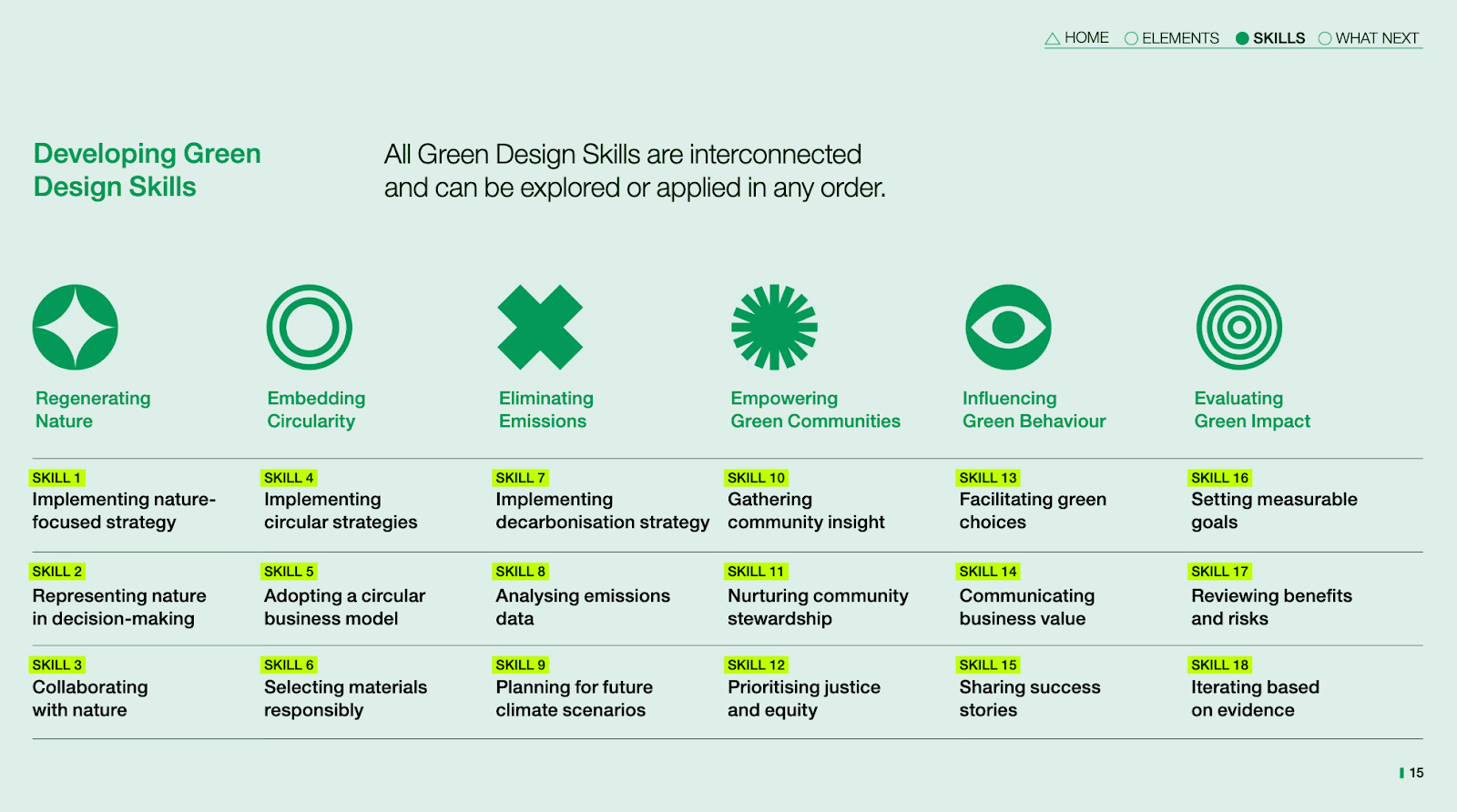
Recently, the UK Design Council, which developed and popularised the double diamond, has released the green skills needed to upskill 1 million designers to design for the planet; this starts with respecting First Nations knowledge, includes critical thinking, co-creation, and expands to regenerative design, circular design, sustainable design, decarbonisation, degrowth, and systems-based solutions.
I may be missing a few of the movements (please add a comment if I have), but the ones listed above are all in the mix of the movements set out to make design accountable for the impacts of its actions and help shore up a nature-positive future for us all.
There are already many designers actively working to push at the boundaries of what design can be — perhaps not quite a million yet, but enough spring seedlings to plant a flourishing garden of possibility with the right weather conditions and nurturing.
Nature Positive Design Glossary
Anthropocene: A suggested new geological epoch that we are presently in, where “human activities have had an environmental impact on the Earth” and is evidenced by the soil, ice and rock core samples that show fragments of modern human life such as nuclear isotopes, soot from burning coal, forever chemicals and shards of technology laid down in the geological records of the Earth.
Biodiversity/biologically inclusive design: An approach to design that seeks to foster functional ecological systems, enable species’ persistence within the built environment and reconnect people with nature. In this approach, nature is actively considered and incorporated into design decisions, be it in products, landscapes or the built environment.
Biomimicry: A method of Learning from nature to solve human problems.
Biophilia: Means ‘love of life’ and is based on the notion that humans have an instinctual tendency to be connected to nature. Applied as a design approach, this brings nature into the design of buildings, spaces and products to maximise the benefits that this connection has.
Bioregional design: A niche but growing approach to design and planning that draws on the local biological resources to create human habitats and products, connected to the biological capacity and culturally appropriate of a specific bioregion (connected to bioregionalism).
Life-centric design: Decentralises humans in the design process and is about inclusive, regenerative and responsible design that aims to provide an environment that supports human health and well-being.
Nature-Positive Architecture: “Considers the ecological impact of structures and aims to create buildings that work in harmony with nature”.
Nature-based solutions: “Leverage nature and the power of healthy ecosystems to protect people, optimize infrastructure and safeguard a stable and biodiverse future”.
Regenerative design: “Co-evolutionary, partnered relationship between humans and the natural environment, rather than a managerial one that builds, rather than diminishes, social and natural capitals”.
Resource Decoupling: This is a proposed approach defined by the United Nations as “using fewer resources per unit of economic output and reducing the environmental impact of any resources that are used or economic activities that are undertaken.”
Sixth Great Extinction: When a lot of biodiversity is lost in a short geological period of time (which could be thousands or millions of years), this is considered a mass extinction. The Earth has experienced several of these, with the sixth currently underway, and it is argued that this is a direct result of human activity.
These approaches and concepts, some niche and some more mainstream, are partly in response to market demand and partly because many creatives want to be part of something positive, contributing to the creation of a better world both locally and globally. It’s worth noting, however, that many of these movements have originated from the fields of architecture and the built environment, so applying them to product/industrial design presents a series of distinct and often difficult challenges. As someone who started their career in eco-design (specifically products and packaging), worked extensively to advance positively disruptive design and has significant expertise in activating the circular economy by design, I can’t stress enough how critical this shift to planet-positive design is; it brings all this evolving progress to a point where designers are decoupling their impact from nature destruction and shifting to modes of creating that restore and regenerate. It seeks to answer the critical question, “How can we create without creating negative impacts?”
It’s also important to outline that the knowledge infused into these movements is not necessarily new; Indigenous peoples have been living and practicing planet-positive co-creation since the beginning of time. As such, all of these modes of considering the complex interconnected systems at play around us when making design choices must include First Nations’ epistemologies. The Indigenous Design Charter is another resource to leverage, as it is helping expand the practices of pre-colonisation worldviews that form the foundations of many attempts to course-correct our unsustainable ways. Similarly, Decolonizing Design calls for a critical reflection on the way contemporary design practice has emerged from a Eurocentric worldview that has avoided and often repressed non-Western approaches, practices, knowledge systems and designerly ways.
Nature-Positive Design Practices
Some of the main practices that support the shift to nature-positive design include systems thinking, circular systems, life cycle thinking, biophilia, and First Nations ecosystem perspectives.
These types of practices can be specific to a place, such as place-based design that is restorative and regenerative. They can take a holistic view of a product or service to ensure that it meets needs (not desires) and expands or extends value over time, such as through circular design that keeps materials in flow for longer. There are many ways of enacting this practice that I believe will emerge from applying it in situ.
So much of what we create as designers is a reaction to the system that we are immersed within, so by changing the set of tools and underlying knowledge/bias/assumptions that one applies and shifting the user or customer base from primarily financially motivated and consumer-centric, we can undoubtedly uncover new concepts, creations and connections.
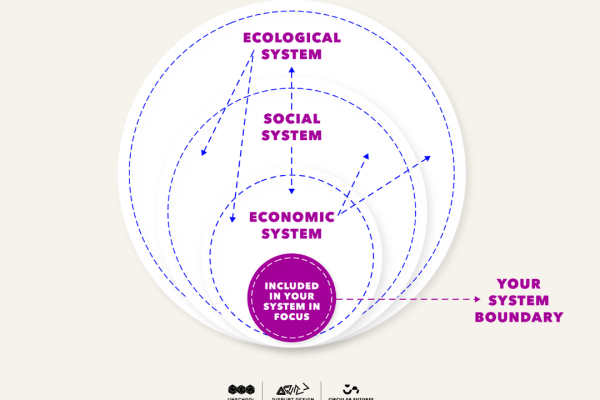
The overarching worldview of nature-positive design is understanding the ecosystem you are working within and actively designing a positive impact to nature as a result of your creation. This directly opposes the present practice of not understanding or considering the impacts that design actions have on the planet, ecosystems and the more-than-humans we share the Earth with.
Something that is currently not nature-positive is AI, as it is a system designed to extract and distract. It’s dirty, thirsty and dangerous. It extracts water and energy from nature to create the massive server banks that power the development of language models and each of the billions of searches performed each day. An astronomical amount of natural resources is needed to feed this hungry distraction, not to mention the materials carelessly extracted to create the chips that power the system. This is degenerative design in action, whereby the economic race to the bottom (a systems archetype) dominates the common sense of what we are creating this system for.
Six tips for activating nature-positive design
- Everything comes from nature, so take the time to uncover the impacts of the materials you use and make choices that either minimise impact or enhance the longevity of materials to ensure that less needs to be extracted from nature.
- Know that all infrastructure created for human needs, whether it be buildings, roads, satellites, data centers or factories, all impact biodiversity. Therefore, actively incorporate design elements that enhance nature’s resilience into your infrastructure.
- Give nature a dominant seat at the table in decision-making and provide a POV that is outside of your own human-centric vantage point. Imagine what types of new solutions could be conceptualized if we moved beyond our reductive human-only perspectives!?
- Seek out impact science that will help inform your decision-making, whether that’s full life cycle assessments or streamlined impact data. Even a quick Google Scholar search of LCA studies in your material/product category will give you gain insights into where impacts to nature occur and help you decide on ways to alleviate these.
- Explore the new biobased or bioregionally available materials that could substitute non-organic materials in your designs — but be sure that the methods of extraction are done in harmony with nature.
- Support actors in your supply chain that are also taking action to incorporate regenerative and life-centric approaches. Seek them out, champion them and collaborate to create new solutions.
—
To conclude, designers of all disciplines must embrace the shift from human-centric design to planet-positive design or we risk designing ourselves out of a planet.
Bringing nature into the mix of stakeholders, considering the impacts that design decisions have on the broader (eco) system and not just mimicking nature, but actively designing within nature’s systems so that outcomes are restorative and regenerative, is the future of design. The question is, will you be a part of this regenerative approach, or will you continue to practice the dominant degenerative design method?
Want to keep learning? Here are my recommendations.
I have been working in the sustainability and regeneration space for over two decades and am deeply passionate about helping to activate positive change. In 2014, I founded The UnSchool of Disruptive Design to share tools for change-making and bridge the knowledge-action gap for those who care deeply about a better future but aren’t sure how to achieve it. If you want to engage more with key aspects of nature-positive design, here are three resources I created to help expand your knowledge set.